
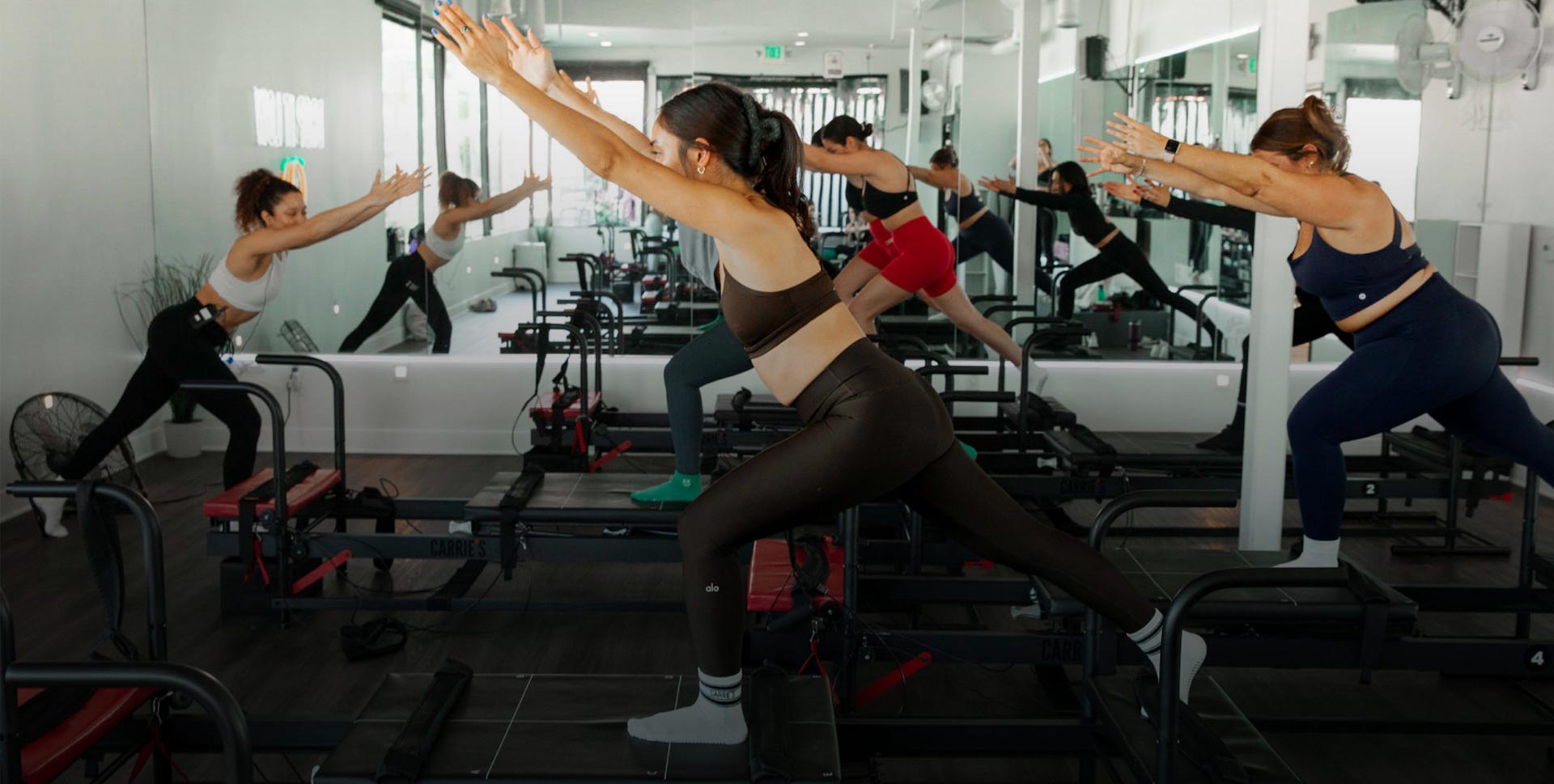
A Pilates group class can be a structured way to work on strength, flexibility, balance, core control, and body awareness.
Group Pilates also gives you instructor guidance and a scheduled time to exercise. For many people, working out alongside others can make Pilates feel more social and engaging.
Whether you are new to Pilates or already have experience, choosing the right class level is important.
What Is a Pilates Group Class and What Are the Benefits?
A Pilates group class brings multiple participants together for an instructor-led workout.
The instructor guides the group through a planned series of exercises. Participants follow the same general class structure while working at a level that is appropriate for their experience.
A group Pilates class may include:
- Core-focused exercises
- Strength movements
- Mobility work
- Controlled movements
- Breathing exercises
- Equipment-based exercises
- Form and alignment instruction
The exact workout depends on the studio, equipment, instructor, and class format.
How Does Group Pilates Training Work?
During a group Pilates class, the instructor demonstrates exercises and provides verbal cues throughout the workout.
You may receive guidance on:
- Body alignment
- Breathing
- Core engagement
- Movement control
- Posture
- Exercise technique
- Movement speed
Everyone participates in the same class, but exercises may be modified based on individual ability.
Beginners can focus on the basic movement patterns, while more experienced participants may use appropriate progressions.
What Are the Benefits of a Pilates Group Class?
Joining a Pilates group class can support several areas of fitness and movement.
Common benefits include:
- Building strength
- Developing core stability
- Supporting flexibility and mobility
- Improving body awareness
- Practicing controlled movement
- Creating a consistent workout routine
- Exercising in a social environment
The results of Pilates vary from person to person. Consistent practice and appropriate instruction are important parts of developing your skills.
1. Build Strength and Core Stability
Many Pilates exercises engage the core while also working muscles throughout the body.
Controlled resistance and repeated movements can help develop muscular endurance and stability.
A group class may include exercises that target:
- Core muscles
- Legs
- Glutes
- Arms
- Back
- Shoulders
The emphasis is generally on controlled movement rather than simply moving as quickly as possible.
2. Support Flexibility and Mobility
Pilates combines controlled movement with exercises that move the body through different ranges of motion.
Regular practice can help you become more familiar with how your body moves.
Mobility-focused exercises can also complement other types of exercise, especially if your routine includes strength training, cardio, or other activities.
3. Develop Better Body Awareness
Body awareness means paying attention to how your body is positioned and moving.
Pilates encourages you to focus on:
- Alignment
- Breathing
- Muscle engagement
- Posture
- Movement range
- Control
This awareness is an important part of learning Pilates technique.
4. Practice Better Movement Control
Pilates emphasizes deliberate movement.
Instead of relying on speed or momentum, you are encouraged to focus on how each movement is performed.
Instructor cues can help you pay attention to:
- Starting position
- Movement direction
- Breathing
- Muscle engagement
- Control
- Return to the starting position
This can make technique an important part of every class.
5. Create a Consistent Fitness Routine
Consistency is an important part of any exercise routine.
Scheduled group Pilates classes can provide structure and make it easier to plan your workouts.
Having a specific class time can also create a routine that you can work into your weekly schedule.
Pilates Group Class Benefits at a Glance
| Benefit | How Group Pilates Can Help |
|---|---|
| Strength | Builds muscular endurance through controlled exercises |
| Core stability | Encourages controlled core engagement |
| Flexibility | Includes mobility and range-of-motion exercises |
| Body awareness | Focuses on alignment and movement |
| Movement control | Emphasizes deliberate exercise technique |
| Consistency | Provides scheduled workout sessions |
| Social connection | Creates a shared fitness environment |
Why Choose Group Pilates Classes?
Group Pilates combines instructor guidance with a shared workout environment.
This can be useful if you enjoy having a planned class structure and working out alongside other people.
Learn With Instructor Guidance
The instructor demonstrates exercises and provides cues throughout the class.
These cues can help you understand:
- How to position your body
- How to use the equipment
- How to coordinate breathing
- How to maintain control
- How to modify an exercise
If you are new to Pilates, instructor guidance can make unfamiliar movements easier to understand.
Stay Motivated With a Scheduled Class
A scheduled class gives you a specific time to exercise.
For some people, this structure makes it easier to stay consistent than planning every workout independently.
The group environment can also provide a sense of accountability.
Enjoy a Social Workout
Some people simply enjoy exercising with others.
A group Pilates class gives you the opportunity to work out in a shared environment while still focusing on your individual movement and technique.
For people who prefer social exercise, this can make Pilates a more enjoyable part of their fitness routine.
Is a Beginner Pilates Class Suitable for Newcomers?
Yes.
A beginner Pilates class can be a good starting point if you have never tried Pilates or are returning after a long break.
Beginner classes typically focus on fundamental movements and basic Pilates principles.
You may learn:
- Basic Pilates positions
- Breathing techniques
- Core engagement
- Alignment
- Controlled movement
- Equipment basics
Learn the Basic Pilates Principles
New participants can begin learning concepts such as:
- Controlled movement
- Breathing
- Concentration
- Alignment
- Core engagement
- Precision
These principles provide a foundation for future Pilates classes.
Understand Proper Form
Proper form is an important part of Pilates.
Beginner instruction can help you understand basic positioning and movement patterns.
If you are unsure about an exercise, ask the instructor for clarification rather than trying to match the pace of more experienced participants.
Progress at a Comfortable Pace
Everyone learns movement skills at a different rate.
When you are new to Pilates, focus on understanding the exercises and maintaining appropriate form.
You do not need to match the resistance, pace, or difficulty of another participant.
What Can You Expect From a Pilates Fitness Class?
A Pilates fitness class generally follows a structured sequence.
The exact format depends on the studio and class type, but you can usually expect a combination of movement preparation, Pilates exercises, technique instruction, and a gradual finish.
Warm-Up and Movement Preparation
The beginning of class may include movements designed to help you focus on breathing, posture, mobility, and body awareness.
Pilates Exercises and Controlled Movement
The main part of the class may include exercises that work the:
- Core
- Legs
- Glutes
- Arms
- Back
- Shoulders
Exercises are generally performed with an emphasis on control and technique.
Breathing and Core Engagement
Breathing and core engagement are incorporated into Pilates movements.
Your instructor may provide cues to help you coordinate breathing with the exercise while maintaining control.
Cooldown and Recovery
Depending on the class format, the session may finish with slower movements, stretching, or mobility work.
This gives you an opportunity to gradually transition out of the workout.
Who Can Benefit From Pilates Group Training?
Group Pilates can work for people with different fitness backgrounds when the class level and format are appropriate.
Pilates Beginners
Beginners can use group classes to learn fundamental Pilates principles in a structured environment.
Instructor demonstrations and cues can make new exercises easier to understand.
Fitness Enthusiasts
People who already exercise can add Pilates to their routine as another way to work on core strength, movement control, mobility, and body awareness.
Social Exercisers
If you enjoy working out with other people, a group class can provide a shared fitness experience.
The social environment can also make it easier to stay engaged with your workout routine.
How to Choose the Right Pilates Group Class
Choosing the right class can affect your comfort and overall experience.
Before booking, consider these factors.
1. Your Experience Level
Look for a class that matches your current Pilates experience.
If you are new to Pilates, consider a beginner or introductory class.
2. The Class Format
Find out what the class includes.
Some Pilates classes may focus more heavily on strength, conditioning, equipment, mobility, or foundational technique.
Choose a format that fits your interests and fitness goals.
3. Instructor Guidance
Look for instructors who provide clear demonstrations and movement cues.
This can be especially important when learning new exercises or equipment.
4. Studio Environment
Consider the type of environment you enjoy.
You may prefer:
- Energetic classes
- Music and instructor encouragement
- A strong community atmosphere
- A more focused workout environment
- Smaller group settings
Finding an environment where you feel comfortable can make it easier to stay consistent.
5. Schedule
Choose a class time that works with your routine.
A convenient schedule can make it easier to attend regularly.
6. First-Time Requirements
Before attending, check the studio’s requirements.
You may need to know:
- What to wear
- Whether grip socks are required
- How early to arrive
- What equipment is used
- How to check in
- Whether beginners need to select a specific class
What Should You Wear to a Pilates Group Class?
Wear comfortable workout clothing that allows you to move freely.
Fitted clothing can also make it easier for an instructor to observe your movement and alignment.
Grip socks may be required depending on the studio.
If you are attending Carrie’s Pilates Trinity Groves, check the studio’s current requirements before your first class.
It is also a good idea to bring water and arrive with enough time to check in before class.
Pilates Group Class vs. Private Pilates
Both group and private Pilates can be useful. The right option depends on how much individual attention you want.
| Group Pilates | Private Pilates |
|---|---|
| Shared class environment | Individual instruction |
| Instructor works with multiple participants | Instructor focuses on one client |
| Scheduled class format | Session can be customized |
| Social workout experience | More time for individual feedback |
| Often useful for regular fitness routines | Useful for technique-focused instruction |
You can also combine the two.
For example, you might use private sessions to focus on specific technique questions and attend group classes as part of your regular workout routine.
Join a Pilates Group Class at Carrie’s Pilates Trinity Groves
A Pilates group class can combine instructor guidance, structured exercise, movement practice, and a social workout environment.
The key is to choose a class that matches your experience level and goals.
At Carrie’s Pilates Trinity Groves, group Pilates provides an opportunity to learn the Carrie’s Method in an instructor-led studio environment. Whether you are new to Pilates or already have experience, the right class can help you build familiarity with the movements and develop your practice over time.
If you are looking for a structured way to add Pilates to your fitness routine, a group class may be a good place to start.
Ready to try Pilates in Trinity Groves?
Explore current classes at Carrie’s Pilates Trinity Groves and find a class that fits your experience and schedule.
Contact the studio to learn more about available Pilates group classes and options for getting started.
Frequently Asked Questions
Yes.
A Pilates group class can be suitable for beginners when the class is designed for introductory or mixed-level participants.
Beginners can learn basic movements, breathing, alignment, and core engagement with instructor guidance.
If you are completely new to Pilates, check the class description or contact the studio to determine which class is the best starting point.
Common benefits include:
Strength development
Core stability
Mobility and flexibility
Body awareness
Movement control
Instructor guidance
Workout consistency
Social connection
The specific experience depends on the class format, instructor, and individual participant.
Pilates group training can include controlled resistance and mobility-focused movements that support muscular endurance, core stability, flexibility, and movement control.
Results vary between individuals and depend on factors such as consistency, class format, and overall fitness routine.
There is no single schedule that works for everyone.
Consider your goals, experience, availability, and overall workout routine.
A schedule that you can maintain consistently is often more practical than choosing a frequency that does not fit your lifestyle.
Your first class may include an introduction to basic Pilates principles, breathing, alignment, and foundational exercises.
You can expect instructor demonstrations and cues throughout the session.
If you are new, let your instructor know. This can help them provide additional guidance when needed.
Group Pilates and private Pilates serve different purposes.
Group classes provide a shared workout environment and scheduled instruction.
Private Pilates provides more individualized attention and allows the session to focus specifically on one person’s technique and goals.
Your choice depends on your preferences and the type of instruction you want.
Yes.
Pilates can be incorporated into many different fitness routines.
People who already participate in strength training, cardio, yoga, or other activities may use Pilates as another type of structured movement practice.
Choose a class that matches your experience and overall training routine.