
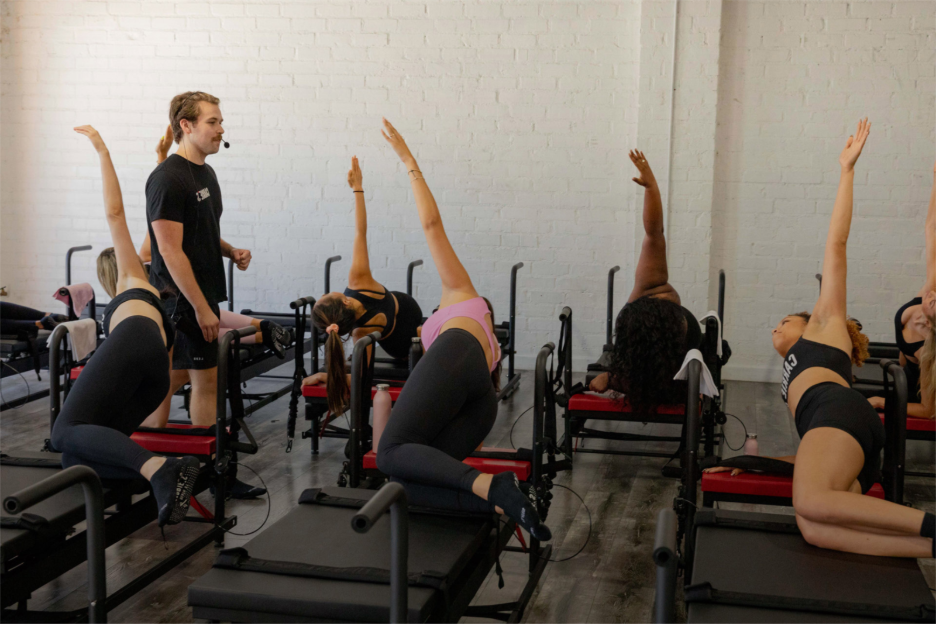
Athletes put a lot of stress on their bodies. Strength training, running, cycling, and sports all require power, endurance, balance, and control.
Pilates can be an effective cross-training workout for athletes. It builds core strength, improves mobility, supports balance, and helps athletes move with better control.
Group Pilates classes also provide expert instruction and the motivation of working out with others.
Is Pilates Good for Athletes?
Yes. Pilates can complement sports and strength training by helping athletes:
- Build core strength
- Improve flexibility and mobility
- Develop better balance
- Strengthen stabilizing muscles
- Improve posture and body control
- Support recovery between workouts
- Reduce muscle imbalances
- Improve overall movement quality
For athletes, Pilates works best as a complement to sport-specific and strength training, rather than a replacement for them.
How Pilates Improves Athletic Performance
Pilates uses controlled movements, resistance, breathing, and body awareness. These techniques help athletes develop better control over how they move.
A strong and stable body can make athletic movements more efficient.
Pilates may help improve:
- Core stability
- Hip and shoulder mobility
- Balance
- Coordination
- Posture
- Muscular endurance
- Movement control
Better movement can help athletes perform training exercises with greater efficiency.
Why Core Strength Matters in Sports
The core supports almost every athletic movement.
A stable core helps connect the upper and lower body. It also supports balance, posture, and force transfer.
Pilates targets deep abdominal, back, and pelvic muscles that may receive less attention during traditional workouts.
A stronger core can help athletes maintain better control while running, lifting, jumping, or changing direction.
Why Pilates Is Effective Cross-Training
Doing the same type of workout every day can place repeated stress on the same muscles and movement patterns.
Cross-training adds variety.
Pilates introduces controlled movements that challenge the body in different ways. It can help athletes work on mobility, stability, coordination, and muscular endurance without adding the same level of impact as some high-intensity workouts.
Pilates can complement:
- Weightlifting
- Running
- Cycling
- CrossFit
- HIIT
- Soccer
- Basketball
- Tennis
- Other recreational and competitive sports
Benefits of Group Pilates Classes for Strength Athletes
Strength athletes often focus on building muscle and increasing lifting capacity. Mobility and stability are also important.
Pilates can complement strength training by working on areas that may be overlooked during heavy resistance workouts.
Improve Mobility Without Losing Strength
Good mobility allows athletes to move through a greater range of motion with control.
Pilates combines stretching with strength work. This can help improve flexibility while maintaining muscular engagement.
Better mobility may also support better exercise technique.
Improve Balance and Functional Movement
Athletic movements rarely use one muscle at a time. Muscles must work together.
Pilates trains the body to control movement while maintaining balance and alignment.
This can help athletes develop better coordination and body awareness.
Pilates for Recovery Between Workouts
Recovery is an important part of athletic training.
A Pilates session can provide movement without the same impact as some intense workouts. Controlled exercises can help keep the body moving while working on mobility and muscle activation.
For athletes, Pilates may be useful on lighter training days or as part of a balanced weekly workout schedule.
Pilates Benefits for Athletes
| Athletic Goal | How Pilates Helps | Potential Benefit |
|---|---|---|
| Core strength | Deep muscle activation | Better stability |
| Mobility | Controlled flexibility work | Greater movement range |
| Balance | Stability and coordination exercises | Better body control |
| Recovery | Low-impact movement | Less stiffness |
| Injury prevention | Balanced muscle development | Better movement mechanics |
| Endurance | Muscular control and resistance | Improved muscular endurance |
How Pilates Complements High-Intensity Training
High-intensity workouts can build strength, endurance, and power. They can also leave muscles tight and place stress on repetitive movement patterns.
Pilates provides a different type of training stimulus.
It focuses on:
- Controlled resistance
- Stability
- Mobility
- Core strength
- Alignment
- Balance
- Body awareness
This makes Pilates a useful addition to a demanding training program.
Pilates for Weightlifters
Weightlifters need strength, stability, and mobility.
Pilates can help strengthen the muscles that support the spine, hips, shoulders, and core. It can also improve movement control.
Better mobility and stability may help athletes maintain better form during strength exercises.
Pilates for Runners
Running involves repetitive movement. Tight hips, weak core muscles, and poor posture can affect running mechanics.
Pilates focuses on core strength, hip stability, posture, and controlled movement.
For runners, these areas can support more efficient movement during training.
Pilates for Cyclists
Cyclists spend long periods in a fixed position. This can place stress on the hips, lower back, and shoulders.
Pilates can help cyclists work on:
- Core strength
- Hip mobility
- Spinal mobility
- Posture
- Flexibility
- Muscle balance
These areas can complement regular cycling workouts.
Reformer Pilates for Team Sport Athletes
Team sports often require sprinting, jumping, stopping, and changing direction quickly.
Reformer Pilates uses spring resistance and controlled movement to challenge strength, stability, and coordination.
This can make it a useful cross-training option for athletes who participate in sports such as:
- Soccer
- Basketball
- Tennis
- Volleyball
- Football
Athletes looking for Pilates classes in Dallas can use reformer sessions to add strength, mobility, and stability work to their regular training.
Pilates and Injury Prevention
Injury prevention is an important part of long-term athletic performance.
Pilates focuses on controlled movement and balanced muscle development. This can help athletes identify and strengthen areas that may be weaker or less stable.
Correcting Muscle Imbalances
Athletes often favor one side of the body. Repetitive sports movements can also cause certain muscles to become stronger or tighter than others.
Pilates trains both sides of the body and targets smaller stabilizing muscles.
This can support better balance between muscle groups.
Supporting Joint Stability and Mobility
Strong muscles help support the joints. Mobility allows joints to move through an appropriate range of motion.
Pilates works on both strength and controlled flexibility.
The result is a training method that focuses on stability without ignoring mobility.
Building Better Movement Patterns
Pilates places an emphasis on movement quality.
Rather than simply performing more repetitions, participants learn to control each movement.
This focus on technique can help athletes develop better movement habits over time.
What to Expect From Pilates Classes in Dallas
Pilates studios offer different types of classes. Athletes should look for programs that provide challenging workouts while maintaining proper technique.
Reformer Pilates Workouts
Reformer Pilates uses a machine with springs and adjustable resistance.
The equipment can make exercises more challenging while keeping movements controlled and low impact.
A reformer workout can combine:
- Strength
- Core training
- Mobility
- Balance
- Muscular endurance
Small Group Classes
Small group Pilates classes offer the energy of a group workout with more opportunity for instructor feedback.
An instructor can help participants:
- Improve their technique
- Adjust resistance
- Modify exercises
- Maintain proper alignment
- Progress safely
This can be especially useful for athletes who want a challenging workout without sacrificing form.
Progressive Training
A good Pilates program should allow participants to progress over time.
Workouts can become more challenging as strength, coordination, and body awareness improve.
This approach allows beginners and experienced athletes to train at an appropriate level.
Choosing the Right Pilates Studio for Cross-Training
Not every Pilates studio offers the same type of workout.
Athletes should consider the class format, equipment, instructors, and overall training environment.
Look for:
- Small group classes
- Reformer equipment
- Experienced instructors
- Structured progression
- Athlete-friendly workouts
- Flexible class times
- Clean and comfortable facilities
Pilates Training for Different Athletes
| Athlete | Pilates Focus | Potential Benefit |
|---|---|---|
| Weightlifters | Core stability and mobility | Better movement control |
| Runners | Hip mobility and posture | More efficient movement |
| Cyclists | Core and spinal mobility | Better posture and flexibility |
| Team sport athletes | Balance and stability | Better body control |
| CrossFit athletes | Mobility and functional movement | More balanced training |
| Beginners | Movement fundamentals | Confidence and technique |
Why Certified Pilates Instructors Matter
Proper instruction is important when adding Pilates to an athletic training program.
A certified instructor can explain technique, adjust exercises, and help participants use proper alignment.
This is especially important when working with resistance equipment such as a reformer.
The right instructor can also help modify exercises for different fitness levels and training goals.
How Often Should Athletes Do Pilates?
Many athletes can benefit from two to three Pilates sessions per week.
The ideal schedule depends on:
- Sport-specific training
- Strength workouts
- Training intensity
- Recovery needs
- Fitness level
- Personal goals
Pilates should fit into the overall training plan rather than create unnecessary additional fatigue.
Creating a Sustainable Cross-Training Routine
The goal of cross-training is to build a stronger and more balanced athlete.
A weekly training plan might combine:
- Sport-specific training
- Strength training
- Pilates
- Cardio or endurance work
- Recovery days
The right combination depends on the athlete and their goals.
Consistency matters more than doing as much training as possible.
Why Dallas Athletes Are Adding Pilates to Their Training
Pilates offers a different approach to fitness. It combines strength, mobility, stability, and controlled movement.
For athletes, this can make it a valuable addition to a traditional training program.
Whether you are a runner, weightlifter, cyclist, CrossFit athlete, or team sport competitor, group Pilates classes can help you build a stronger foundation for movement.
Ready to add Pilates to your cross-training routine?
Explore Pilates classes at Carrie’s Pilates Plus and discover how reformer Pilates can support your strength, mobility, balance, and athletic performance.
Frequently Asked Questions
Is Pilates good for athletes?
Yes. Pilates can complement athletic training by improving core strength, mobility, balance, stability, and movement control.
How often should athletes attend Pilates classes?
Many athletes can benefit from two to three Pilates sessions per week. The ideal frequency depends on the athlete’s overall training schedule and recovery needs.
Can Pilates improve lifting performance?
Pilates can support lifting by strengthening stabilizing muscles and improving mobility, posture, and body control. These improvements can contribute to better lifting technique.
Are group Pilates classes good for beginners?
Yes. Beginners can learn the basic movements and gradually increase the difficulty as they become stronger and more comfortable.
Should Pilates replace strength training?
No. For most athletes, Pilates works best as a complement to strength and sport-specific training.
Is reformer Pilates good for athletes?
Yes. Reformer Pilates uses adjustable spring resistance to challenge strength, stability, and coordination while keeping movements controlled and low impact.
What should I bring to my first Pilates class?
Wear comfortable athletic clothing that allows you to move freely. Bring water and grip socks if required by the studio. Arriving a few minutes early can also give you time to meet the instructor and learn about the equipment.
Final Takeaway
Pilates can be a powerful cross-training tool for athletes.
It helps train areas that are sometimes overlooked in traditional workouts, including core stability, mobility, balance, coordination, and movement control.
For Dallas athletes, adding group reformer Pilates to a balanced training routine can provide a fresh way to build strength and improve overall movement quality.
Frequently Asked Questions
A
Yes. Pilates can complement athletic training by improving core strength, mobility, balance, stability, and body control. It can be added to training programs for runners, weightlifters, cyclists, CrossFit athletes, and team sport athletes.
Pilates can support athletic performance by strengthening stabilizing muscles and improving mobility, coordination, posture, and movement control. These benefits can help athletes move more efficiently during training and competition.
Yes. Pilates is an effective cross-training option because it challenges the body in ways that differ from traditional strength and cardio workouts. It focuses on controlled movement, core strength, mobility, balance, and stability.
Many athletes can benefit from two to three Pilates sessions per week. The ideal schedule depends on the athlete’s sport, training volume, fitness level, and recovery needs.
Yes. Pilates can help runners work on core strength, hip stability, posture, balance, and mobility. These areas can support efficient running mechanics and complement regular running workouts.
Yes. Pilates can complement weightlifting by improving core stability, mobility, balance, and movement control. It can be especially useful for working on the hips, shoulders, and spine.
Yes. Reformer Pilates uses spring resistance to challenge strength, stability, coordination, and muscular endurance. The adjustable resistance allows exercises to be modified for different fitness levels and goals.
Yes. Beginners can join group Pilates classes when the studio offers appropriate instruction and exercise modifications. New participants can learn basic movements and gradually progress as their strength and coordination improve.
Pilates may support injury prevention by improving muscle balance, mobility, stability, and movement control. However, no exercise program can guarantee that an athlete will avoid injury.
No. Pilates is generally best used as a complement to strength and sport-specific training. It can add mobility, core stability, balance, and controlled resistance work to an existing workout routine.
Athletes should look for experienced instructors, quality reformer equipment, small group classes, structured progression, flexible scheduling, and workouts that can be adapted to different fitness levels.
Yes. Group classes provide the structure and motivation of a shared workout while allowing participants to develop strength, mobility, balance, and body awareness under instructor guidance.
Wear comfortable athletic clothing that allows unrestricted movement. Grip socks may also be required, depending on the Pilates studio.
Dallas athletes can find Pilates studios offering group and reformer classes throughout the area. Look for a studio that offers experienced instruction, quality equipment, and classes that match your fitness level and cross-training goals.
Yes. Pilates can complement high-intensity training by focusing on mobility, stability, core strength, and controlled movement. Athletes should balance workout intensity with adequate recovery.