
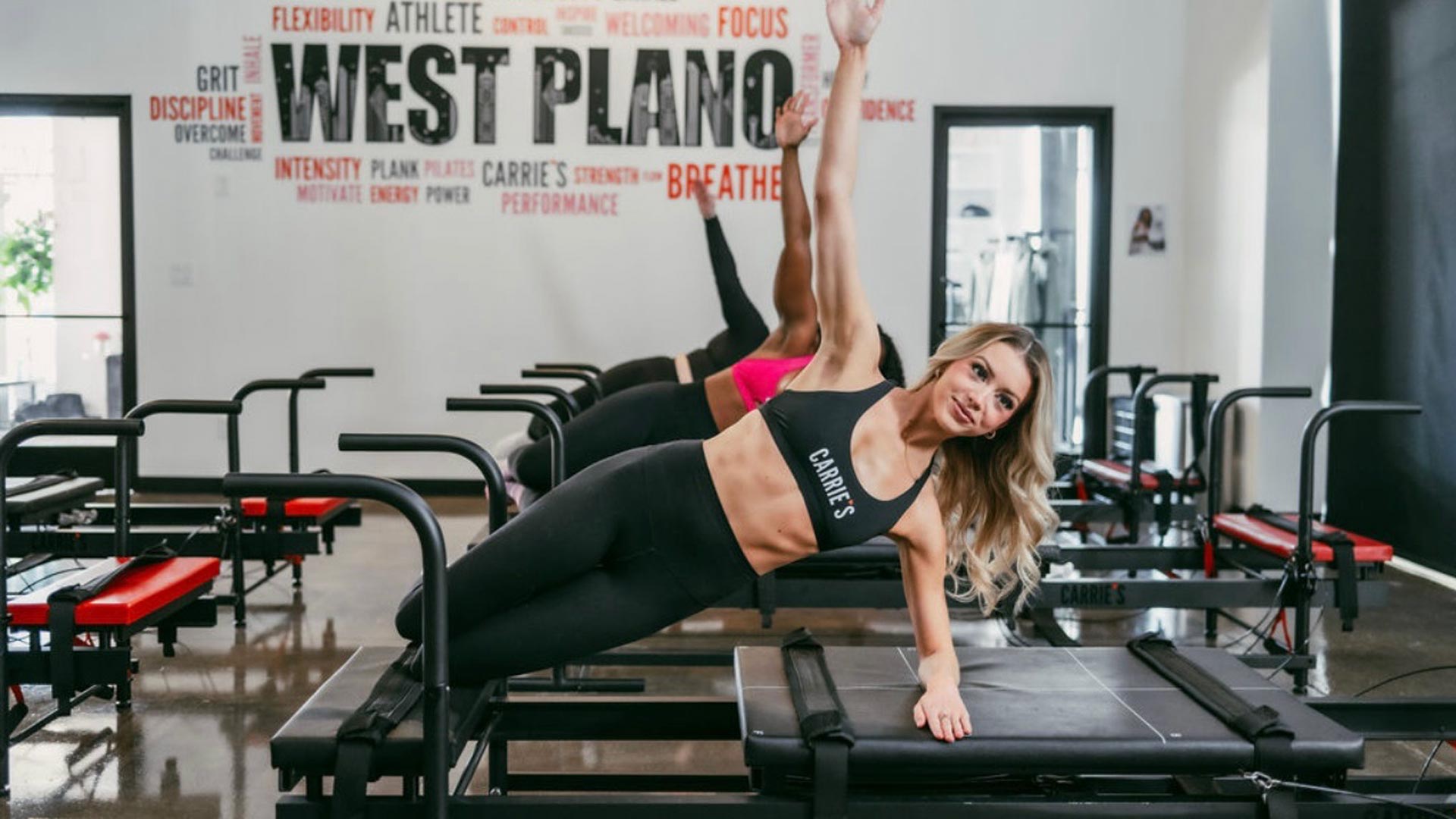
If you’re looking for Pilates in Dallas and are new to the workout, Trinity Groves is a great place to begin. Pilates combines controlled movement, core-focused exercises, strength training, and flexibility work in a low-impact format.
At Carrie’s Pilates Plus Trinity Groves, beginners can learn the fundamentals with expert instruction and modern equipment, including Carrie’s Transformer.
Not sure what to expect from your first class? This guide explains how Pilates works, what beginners should know, and how to build a consistent Pilates routine in Dallas.
What Is Pilates? How do Beginners Approach Pilates?
Pilates is a form of exercise built around controlled movement, core engagement, alignment, breathing, and body awareness.
Unlike workouts that rely mainly on speed or heavy lifting, Pilates emphasizes how you move. Exercises can be adjusted to match your fitness level and experience.
A regular Pilates practice may help you:
- Build core and overall strength
- Improve flexibility and mobility
- Develop better body awareness
- Support posture and alignment
- Improve balance and coordination
- Create a low-impact fitness routine
- Reduce everyday stress through focused movement
Pilates can be a good option for beginners, active adults, athletes, and people returning to exercise after time away.
Why Try Pilates in Dallas?
Dallas has a wide range of fitness options, from traditional gyms to boutique studios and group training programs. Pilates stands out because it combines strength, mobility, control, and focused movement in one workout.
For beginners, that combination can make Pilates easier to approach than a high-impact workout.
You don’t need to be flexible or already fit to start. A good beginner class should teach you the basic movements and allow you to build your skills over time.
Why Choose Trinity Groves for Pilates?
Trinity Groves offers a convenient Dallas location for people who want a modern studio experience with instructor-led Pilates classes.
At Carrie’s Pilates Plus, you can expect:
- Expert-led instruction
- Guided group workouts
- A modern studio environment
- Focus on proper form and controlled movement
- Workouts that can be modified for different fitness levels
- Carrie’s Transformer equipment
The goal is to give beginners a clear starting point while providing enough challenge to keep the workout engaging as they progress.
What Is Carrie’s Transformer?
If you’re familiar with a traditional Pilates Reformer, Carrie’s Transformer uses some of the same basic principles of resistance-based Pilates while offering a different studio workout experience.
The equipment uses resistance to challenge your muscles while you perform controlled movements.
Carrie’s Transformer can be used for exercises that target:
- Core strength
- Legs and glutes
- Arms and shoulders
- Balance and stability
- Flexibility and mobility
- Full-body strength
The resistance can be adjusted, which allows instructors to modify exercises for different experience levels.
Is Carrie’s Transformer Good for Beginners?
Yes. Beginners can learn the basic movements and equipment setup with instructor guidance.
The important thing is not to start with the most difficult version of an exercise. Your instructor can help you learn the correct technique and increase the challenge as you become more comfortable.
Pilates Reformer vs. Carrie’s Transformer
Both Pilates Reformers and Carrie’s Transformer use resistance-based movement, but the workout experience can differ.
Pilates Reformer | Carrie’s Transformer |
|---|---|
Traditional Pilates equipment | Modern resistance-based Pilates equipment |
Controlled, precise movements | Dynamic, full-body movements |
Adjustable resistance | Adjustable resistance |
Common in private and group Pilates | Designed for instructor-led studio workouts |
Strong focus on technique and control | Combines strength-focused movement with a more dynamic pace |
The best option depends on your goals, preferences, and the type of Pilates experience you want.
What Types of Pilates Classes Can Beginners Take?
If you’re searching for Pilates classes in Dallas, you’ll find several types of workouts.
1. Beginner Pilates Classes
Beginner classes introduce the basic principles of Pilates.
You may learn:
- Basic Pilates positions
- Core engagement
- Breathing techniques
- Proper alignment
- How to use the equipment
- How to control each movement
These classes are a good starting point if you’ve never tried Pilates before.
2. Group Pilates Classes
Group classes provide instructor-led workouts in a studio environment.
They can be a good choice if you enjoy:
- A scheduled workout
- Training with other people
- Instructor guidance
- A motivating studio environment
- A structured routine
You don’t need to be an experienced Pilates student to participate in a beginner-friendly group class.
3. Private Pilates Sessions
Private Pilates provides one-on-one instruction.
This format can be useful if you want more individualized attention, need exercise modifications, or prefer learning at your own pace.
Private training may also be helpful when you’re returning to exercise after an injury, although anyone with a current injury or medical concern should follow guidance from their healthcare professional.
What Should You Expect in Your First Pilates Class?
Starting a new workout can feel intimidating. Knowing what to expect can make the experience much easier.
Before Class
Plan to:
- Wear comfortable clothing that allows you to move
- Arrive a little early
- Bring water
- Let your instructor know you’re new
- Mention any relevant physical limitations or concerns
You don’t need to know the exercises before you arrive. That’s what your instructor is there to teach you.
During Class
Your instructor will demonstrate and explain the exercises.
You’ll focus on:
- Controlled movement
- Proper alignment
- Breathing
- Core engagement
- Following the instructor’s cues
- Using the equipment correctly
Don’t worry if you don’t get every movement right immediately. Pilates is a skill that improves with practice.
After Class
You may notice that your muscles feel like they’ve worked harder than expected, especially if you’re new to resistance-based exercise.
Drink water, allow your body to recover, and give yourself time to learn the movements.
Why Do Beginners Like Pilates?
One reason Pilates appeals to beginners is that the workout can be challenging without requiring high-impact movements.
You can start with basic exercises and gradually increase resistance, complexity, or workout intensity.
Many beginners appreciate that Pilates:
- Doesn’t require advanced fitness skills
- Can be modified for different ability levels
- Builds strength progressively
- Encourages body awareness
- Offers a structured workout
- Provides instructor feedback
Most importantly, you don’t have to be “good at Pilates” before you start.
How Often Should Beginners Do Pilates?
Consistency is more important than trying to do too much too soon.
A general starting point might look like this:
Experience | Suggested Frequency |
|---|---|
New to Pilates | 2–3 classes per week |
Regular Pilates student | 3–4 classes per week |
Advanced student | Based on goals, training load, and recovery |
Two or three consistent sessions each week can give beginners enough practice to learn the movements while allowing time for recovery.
Your ideal schedule may vary based on your other workouts, fitness goals, and how your body responds to training.
7 Tips for Getting More From Pilates
1. Focus on Form
Don’t rush through an exercise just to complete more repetitions. Controlled movement is a key part of Pilates.
2. Start With the Right Resistance
More resistance doesn’t automatically mean a better workout. Use a level that allows you to maintain good form.
3. Listen to Your Instructor
Small adjustments can make a major difference in how an exercise feels and where you feel the work.
4. Be Consistent
Regular classes help you become more familiar with the movements and equipment.
5. Don’t Compare Yourself to Others
Everyone starts at a different fitness level. Focus on your own progress.
6. Give Yourself Time
Strength, mobility, coordination, and confidence develop through consistent practice.
7. Recover When You Need To
Rest is part of a good fitness routine. Give your body time to recover when you’re especially sore or fatigued.
Common Pilates Mistakes Beginners Should Avoid
A few simple mistakes can make learning Pilates harder than it needs to be.
Rushing Through Movements
Pilates is based on control. Moving too quickly can make it harder to maintain proper form.
Using Too Much Resistance
More resistance can make an exercise harder, but it can also make it difficult to maintain good technique.
Holding Your Breath
Breathing is an important part of Pilates. Follow your instructor’s breathing cues rather than holding your breath during challenging movements.
Trying to Do Everything Perfectly
You won’t master every exercise during your first class. Focus on learning the basics.
Skipping Beginner Classes
Starting at the right level gives you time to understand the equipment, movement patterns, and terminology before progressing.
Pilates vs. Other Workouts
How does Pilates compare with other popular forms of exercise?
Workout | Primary Focus |
|---|---|
Pilates | Core strength, controlled movement, mobility, balance |
Traditional strength training | Building muscular strength through resistance |
Yoga | Mobility, flexibility, balance, breathing, mindfulness |
Cardio | Cardiovascular fitness and endurance |
HIIT | Short periods of higher-intensity exercise |
Pilates can also complement other types of exercise. For example, someone who runs, lifts weights, or participates in sports may use Pilates as part of a broader fitness routine.
Can Pilates Help With Weight Loss?
Pilates can contribute to an active lifestyle and burns calories while you exercise. However, weight loss depends on several factors, including overall activity, nutrition, sleep, and individual metabolism.
If weight loss is your goal, Pilates can be one part of a balanced fitness program rather than the only form of exercise you rely on.
Who Should Try Pilates in Dallas?
Pilates can be a good option for a wide range of people, including:
- Pilates beginners
- Busy professionals
- Adults returning to exercise
- People who prefer low-impact workouts
- Athletes looking to complement their training
- People who enjoy instructor-led group fitness
- Anyone interested in improving strength, mobility, and body awareness
If you have a current injury, medical condition, or specific physical limitation, talk with your healthcare professional before starting a new exercise program and tell your Pilates instructor about any relevant restrictions.
Why Trinity Groves Is a Convenient Dallas Pilates Location
For people living or working in and around Dallas, Trinity Groves provides an accessible location for an instructor-led Pilates workout.
Instead of trying to learn Pilates on your own, you can attend a structured class, learn the equipment, and receive guidance throughout the workout.
That can make the transition into a new fitness routine much easier.
Start Pilates in Dallas at Trinity Groves
Starting Pilates doesn’t have to be complicated.
At Carrie’s Pilates Plus Trinity Groves, beginners can learn the fundamentals, work with expert instructors, and experience a modern approach to Pilates using Carrie’s Transformer.
Whether you’re looking for beginner Pilates classes, group Pilates classes, or a new way to build strength and mobility, Trinity Groves offers a welcoming place to start.
Ready to try Pilates in Dallas?
Book your first class at Carrie’s Pilates Plus Trinity Groves and start building your Pilates practice one workout at a time.
Frequently Asked Questions About Pilates Dallas
Yes. Pilates can be adapted for beginners. A beginner-friendly class introduces the basic movements, equipment, breathing, and alignment before progressing to more challenging exercises.
Wear comfortable, fitted workout clothing that allows your instructor to see your alignment and lets you move freely. Grip socks may also be recommended depending on the studio.
Many studio Pilates classes run approximately 45–60 minutes, although class length can vary.
Starting with 2–3 classes per week is a reasonable schedule for many beginners. Your ideal frequency depends on your goals, other workouts, and recovery needs.
Yes. Pilates generally uses controlled movements rather than high-impact exercises such as jumping or running. It can still provide a challenging strength workout.
Carrie’s Transformer is resistance-based Pilates equipment used at Carrie’s Pilates Plus. It provides a platform for full-body exercises that can be adjusted for different fitness levels.
Absolutely. You don’t need to be flexible to start Pilates. Flexibility and mobility can improve as you practice consistently.
Both can be effective. Group classes provide a structured and social workout, while private sessions provide more individualized instruction and attention.